Why are the planets so different?
Scrollable formula. Use Left and Right arrow keys to reveal hidden content.
Scrollable table. Use Left and Right arrow keys to reveal additional columns.
Scrollable figure. Use Left and Right arrow keys to inspect hidden content.
https://blackhole.org/universe/solar-system/planetary-worlds/
Planets share an origin in disks around young stars, but they do not all grow from the same ingredients or keep the same atmospheres. Their masses, formation conditions and later histories produce rocky landscapes, deep fluid interiors, icy moons and rings. Comparing the worlds in our Solar System helps us decide what a picture reveals—and what needs a different measurement.
Rocky ground and cloudy giants
Section titled “Rocky ground and cloudy giants”Look first at the Moon and Jupiter below. Which image gives you evidence of a solid surface? Which shows a moving atmosphere? Their displayed sizes are chosen for readability, not to compare their diameters.
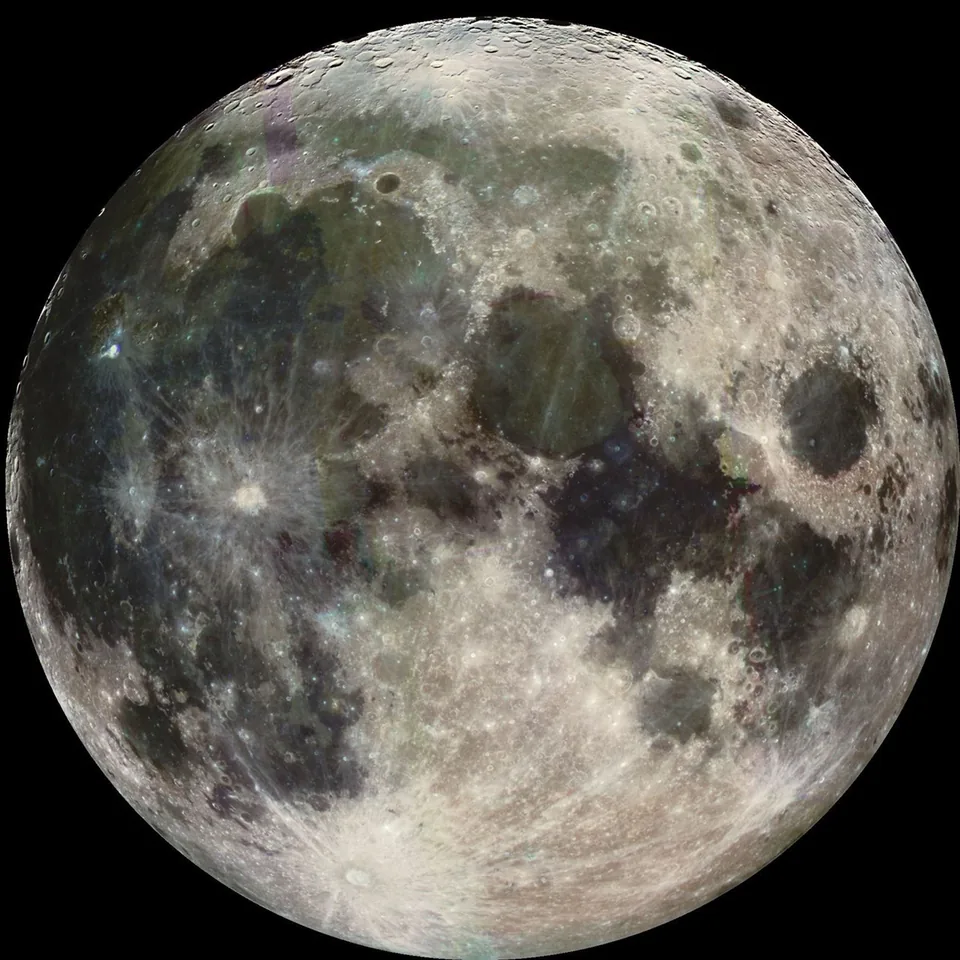
Galileo's Moon composite combines violet and near-infrared measurements; the displayed colour is enhanced. The dark plains and bright crater rays are surface features.
Credit: NASA/JPL/USGS. Image source · Reuse terms
About this observation
Galileo camera composite, 7 December 1992; violet, 756 nm and 968 nm filters. Enhanced colour includes near-infrared measurements invisible to human vision. This is one composite view of lunar terrain, rather than a sequence of changing phases.
Resized for this page; displayed images retain the source's colors and full frame. These images do not share a common physical scale.
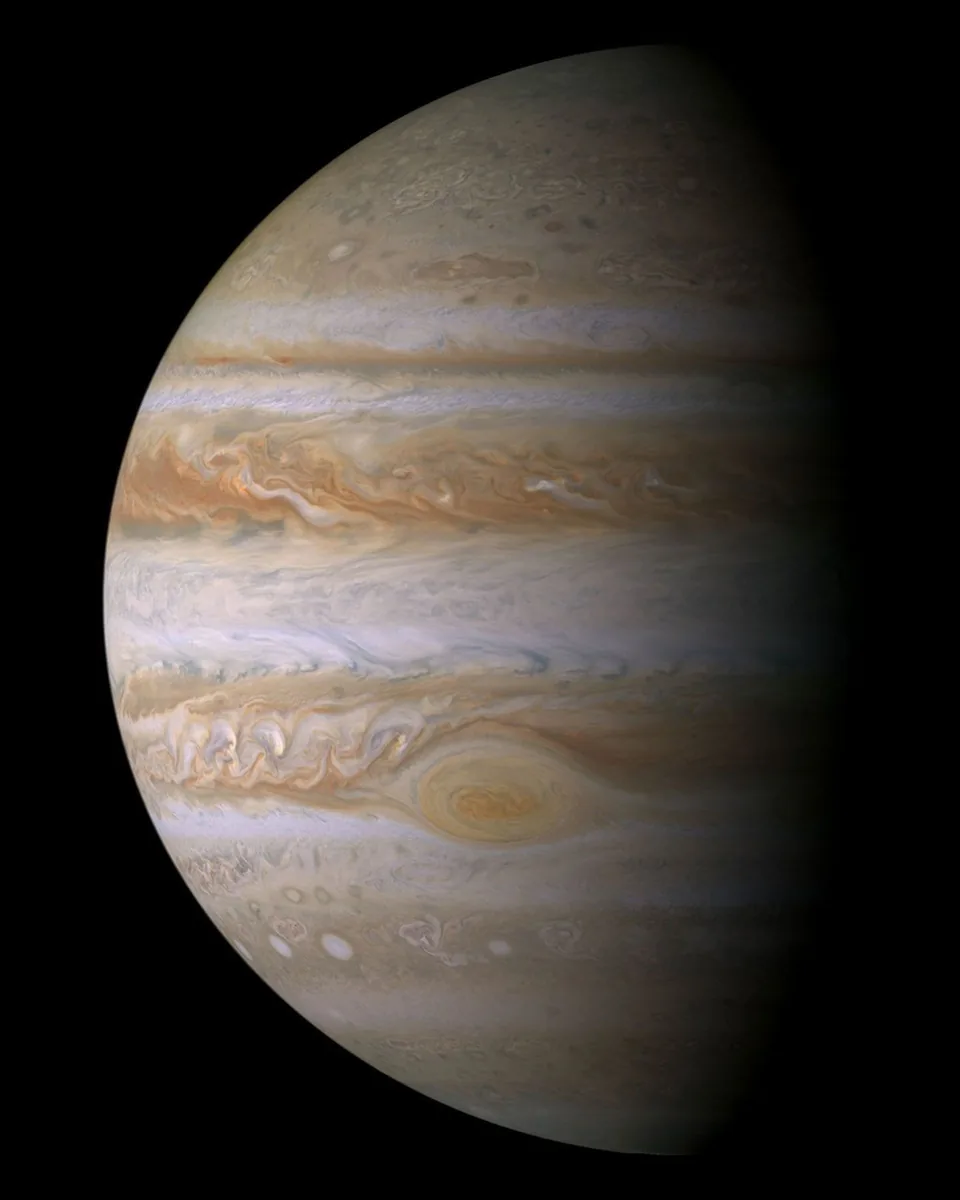
Cassini's red, green and blue camera exposures form an approximately natural-colour mosaic of Jupiter's cloud tops.
Credit: NASA/JPL/Space Science Institute. Image source · Reuse terms
About this observation
Cassini narrow-angle camera, 29 December 2000; 27 frames at nine positions through red, green and blue filters. Mosaic approximately reproducing human-eye colours. The visible surface is cloud tops, not solid ground.
Resized for this page; displayed images retain the source's colors and full frame. These images do not share a common physical scale.
On the Moon, impact craters and the long rays of material thrown out by impacts remain visible on the ground. On Jupiter, the bands and swirls belong to clouds. Beneath them, pressure and temperature increase with depth; there is no solid surface on which a spacecraft could land as it could on the Moon.
The Solar System’s four inner planets—Mercury, Venus, Earth and Mars—are rocky planets, with interiors dominated by rock and metal. Jupiter and Saturn are gas giants, made mainly of hydrogen and helium. The name does not mean they are gas all the way down: under enormous pressures their material behaves very differently from an ordinary gas. NASA, “About the Planets,” §§ Inner Planets and Outer Planets
Uranus and Neptune are called ice giants because compounds such as water, ammonia and methane make a larger contribution to their interiors than in Jupiter and Saturn. Here “ice” is a historical name for ingredients, not a claim that a giant planet is a frozen snowball. Much of that material is hot and under high pressure. NASA, “Neptune Facts,” §§ Structure and Surface
Size and density reveal different things
Section titled “Size and density reveal different things”An image alone does not measure a planet’s mass. Gravitational effects on moons and spacecraft help determine mass; measured size then gives bulk density, the average mass per unit volume of the whole object. Compare these rounded values before looking at the question beneath the table.
| World | Mean radius (km) | Bulk density (g/cm³) | Broad description |
|---|---|---|---|
| Earth | 6,371 | 5.51 | Rocky planet |
| Jupiter | 69,911 | 1.33 | Gas giant |
| Saturn | 58,232 | 0.69 | Gas giant |
| Neptune | 24,622 | 1.64 | Ice giant |
| Ceres | 470 | 2.16 | Dwarf planet containing rock and water-bearing material |
The mean radius is that of a sphere with the same volume. Densities describe whole worlds, not the density of every layer. Numerical values are rounded from JPL Solar System Dynamics, “Planetary Physical Parameters,” planet and dwarf-planet tables and column definitions. Ceres’s composition is discussed in NASA, “Ceres Facts,” § Structure.
Compare: Jupiter is much larger than Earth but less dense. Does that mean it has less mass?
Show the explanation
No. A much larger volume can outweigh a lower average density. Jupiter has about 1,321 times Earth’s volume but about 318 times its mass. Dividing those ratios gives roughly one-quarter of Earth’s bulk density. “Less dense” and “less massive” answer different questions.
Density is a clue to composition, but it is not a unique recipe. Different mixtures, layer structures and amounts of compression can produce similar averages. Astronomers combine it with spectra, gravity measurements and models of materials under pressure.
Moons and rings are worlds and systems too
Section titled “Moons and rings are worlds and systems too”Europa orbits Jupiter, yet its visible surface is water ice rather than Jupiter-like clouds. Compare its fractures with the Moon’s cratered terrain above. Europa’s surface patterns and Galileo’s magnetic measurements support an ocean beneath the ice, but the photograph itself does not show liquid water below ground. A moon’s location around a planet does not make its geology uninteresting or establish whether it supports life. NASA, “Europa Facts,” §§ Structure, Surface and Magnetosphere
Now compare Europa with Saturn’s rings. A moon is a distinct body; the rings are countless separate orbiting particles, chiefly ice with other material. Their apparently smooth appearance results from seeing so many unresolved particles together. NASA, “Saturn Facts,” § Rings
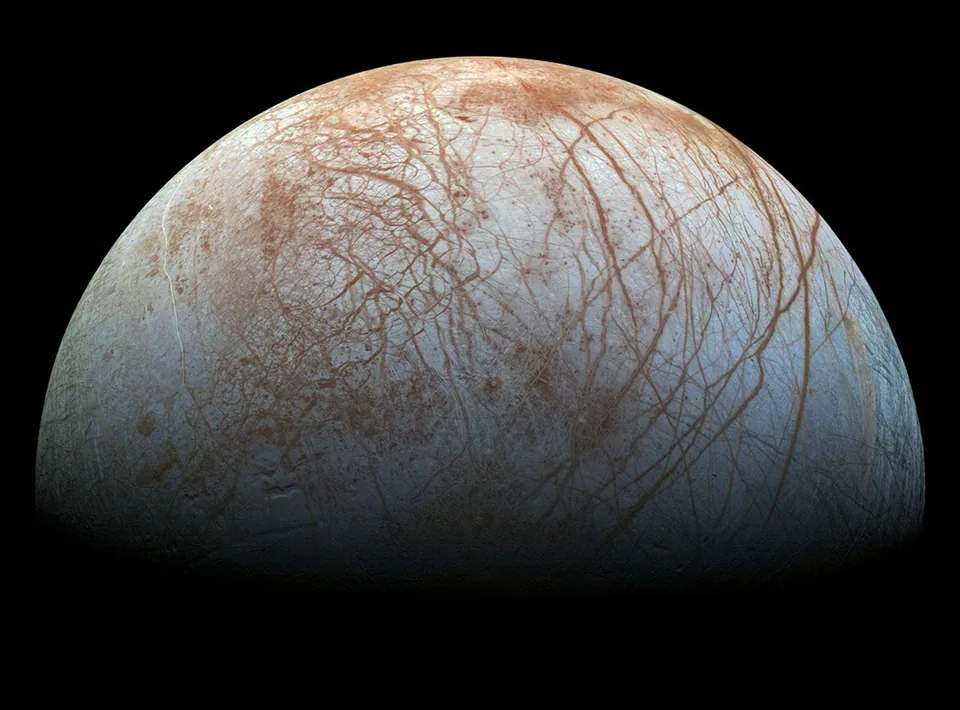
Galileo's reprocessed view shows Europa's fractured ice. The mosaic approximates natural colour and fills data gaps with colours inferred from similar nearby terrain; it does not show an ocean or life.
Credit: NASA/JPL-Caltech/SETI Institute. Image source · Reuse terms
About this observation
Galileo SSI, 1995 and 1998; near-infrared, green and violet exposures; reprocessed release 21 November 2014. Wavelength-calibrated mosaic approximates human-eye colour; gaps filled using simulated colour from similar nearby terrain. North at right in original.
Resized for this page; displayed images retain the source's colors and full frame. These images do not share a common physical scale.
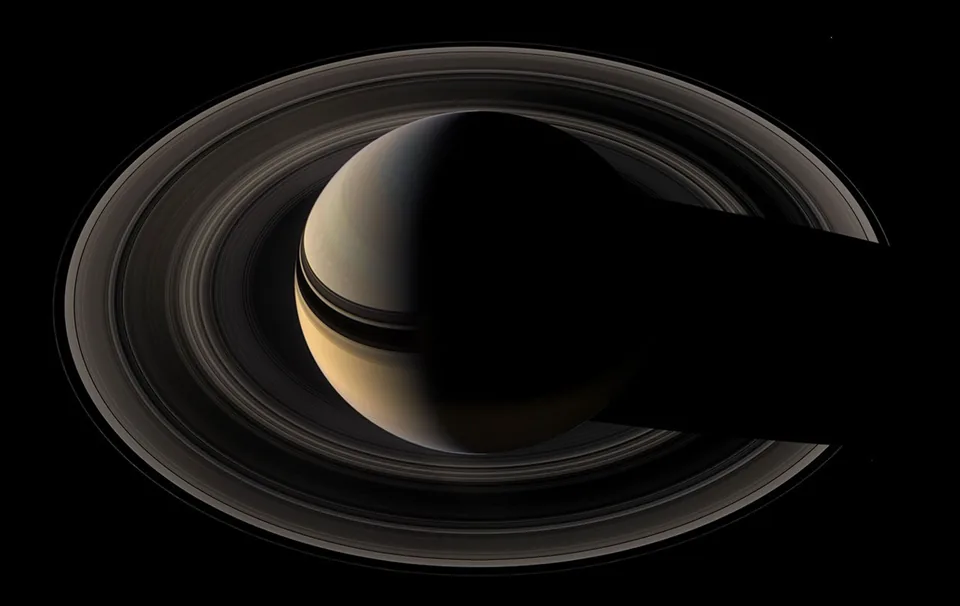
Cassini photographed Saturn and the unilluminated side of its rings in red, green and blue light. The rings consist of orbiting material, not a solid plate.
Credit: NASA/JPL/Space Science Institute. Image source · Reuse terms
About this observation
Cassini wide-angle camera, 9 May 2007; 45 frames in 15 red/green/blue sets. Natural-colour mosaic, viewed from above the unilluminated side of the rings. Ring darkness depends on viewing geometry. This frame and the Jupiter frame use different physical scales.
Resized for this page; displayed images retain the source's colors and full frame. These images do not share a common physical scale.
Small bodies add still more variety. Many asteroids are irregularly shaped, and their compositions include different mixtures of minerals and metals. They preserve evidence of early Solar System material and subsequent collisions; they are not simply interchangeable spare rocks. Ceres, in the asteroid belt, is large enough to be nearly round and is classified as a dwarf planet. NASA, “Asteroid Facts,” §§ Overview and Composition
Ingredients and history make the differences
Section titled “Ingredients and history make the differences”The young Solar System had a hotter inner disk and colder regions farther out. Temperature affected which materials could remain solid. Growing bodies that acquired large envelopes while gas was still available could become giants. Later collisions, migration, heat loss and atmospheric escape changed the worlds further. Today’s distance from the Sun is therefore only part of the explanation; planetary formation follows the process in more detail. NASA, “Solar System Facts,” §§ Formation and Structure
Even two rocky planets of similar size need not have similar conditions. Venus and Earth have nearly equal radii, but Venus has a thick carbon-dioxide atmosphere and a much hotter surface. An Earth-sized world is not automatically Earth-like or habitable. NASA, “Venus Facts,” § Atmosphere
Show the math: a planet’s average density
Preparation: multiplication, division and cubes.
For mass and volume-equivalent mean radius ,
Using Earth’s mass kg and mean radius m gives about kg/m³, or g/cm³. The unit conversion uses g/cm³ kg/m³. These inputs are from the JPL table cited above.
For two worlds, taking a ratio removes the shared geometrical factor:
A hypothetical world with twice Earth’s radius and eight times its mass has Earth’s average density. It need not have Earth’s atmosphere, temperature or interior layers. The equation relates bulk properties; it does not identify a unique composition.
Choose the next measurement
Section titled “Choose the next measurement”A newly discovered world has roughly Earth’s radius. One team wants to call it a rocky, habitable planet immediately. Choose two useful next measurements and explain what each would test.
Show an answer
A mass estimate would allow a bulk-density comparison and help test whether a large low-density envelope is plausible. A spectrum could test atmospheric composition, although clouds and limited data may hide or confuse features. Neither measurement alone proves habitability or life. Stellar radiation, orbital distance and an atmospheric model are also needed to investigate the world’s conditions.
Continue with how astronomers find planets around other stars, or ask what makes a world potentially habitable.
For classrooms and clubs
Objective: separate visible appearance, measured bulk properties and inferred interior conditions. No astronomy background is required; the optional calculation uses ratios and cubes.
In 15 minutes: compare the Moon, Jupiter, Europa and Saturn images or their text descriptions. For each, name one visible feature, one physical interpretation and one question the image cannot answer. Useful distinctions include clouds versus ground, ice versus an inferred ocean, and an unresolved ring versus a solid plate.
In 30 minutes: use the table to challenge “bigger means denser,” then construct two hypothetical planets with the same bulk density but different radius and mass. Doubling radius requires eight times the mass. Ask why equal density does not establish equal habitability. Use the written feature descriptions for a nonvisual version; no colour discrimination is required.
References
Section titled “References”- JPL Solar System Dynamics. Planetary Physical Parameters. Planet and dwarf-planet tables, column descriptions and original-source references. Data table. Accessed 28 September 2026.
- NASA Science. About the Planets. Planet categories. Accessed 28 September 2026.
- NASA Science. Asteroid Facts. Overview and composition. Accessed 28 September 2026.
- NASA Science. Ceres Facts. Structure. Accessed 28 September 2026.
- NASA Science. Europa Facts. Structure, surface and magnetic evidence. Accessed 28 September 2026.
- NASA Science. Neptune Facts. Interior and atmosphere. Accessed 28 September 2026.
- NASA Science. Saturn Facts. Rings. Accessed 28 September 2026.
- NASA Science. Solar System Facts. Formation and structure. Accessed 28 September 2026.
- NASA Science. Venus Facts. Atmosphere. Accessed 28 September 2026.
Image credits, source records, wavelength information and reuse terms accompany each observation above.