How does a cloud become a star?
Scrollable formula. Use Left and Right arrow keys to reveal hidden content.
Scrollable table. Use Left and Right arrow keys to reveal additional columns.
Scrollable figure. Use Left and Right arrow keys to inspect hidden content.
https://blackhole.org/universe/stellar-evolution/star-formation/
A star can begin in one of the coldest places in a galaxy: a dense cloud of gas and dust. Gravity gathers some of that material into a much smaller region. The surprising result is an object that gets hotter and shines—even before sustained hydrogen fusion powers its core.
Here we follow the broad formation of a low-mass star like the Sun. It is a possible physical pathway, not a recipe that turns every cloud into one star or assigns every stage the same duration.
Cold clouds can collapse under their own gravity
Section titled “Cold clouds can collapse under their own gravity”Molecular clouds contain gas, much of it hydrogen in molecules, mixed with a small amount of dust. Some regions are only around 10 kelvin above absolute zero. The material is cold and spread out, yet a sufficiently large collection can have enough mutual gravitational attraction to pull itself together (NASA, “How Do Stars Form?”).
Gravity is not the only influence. Gas pressure resists compression; magnetic fields and motions within the cloud affect whether particular regions gather or disperse. A dense region can collapse when gravity overcomes the available support. A big cloud can fragment into many smaller regions, helping form groups of stars rather than one enormous object.
Cooling matters here. When gas loses energy by radiation, pressure can provide less resistance to further compression. Molecules and dust help transfer energy into escaping radiation. As matter gathers more densely, radiation escapes less freely and a hot central object develops. NASA’s formation account describes the roles of cooling, gravity, gas pressure, and magnetic fields (NASA, “A Star Is Born,” opening formation account).
“Cold cloud” and “hot center” therefore describe different parts of a changing system. They are not contradictory descriptions of one uniform temperature.
Read the edge of a stellar nursery
Section titled “Read the edge of a stellar nursery”In Hubble’s visible-light view of the Pillars of Creation, look for dark columns outlined by bright gas. The dark shapes contain dust that obscures light; radiation and winds from nearby young stars illuminate and erode the surrounding material. The displayed colours represent selected emission-line bands, not the colours an eye would necessarily see. ESA/Hubble 2015, “New View of the Pillars of Creation—Visible,” image description and colours
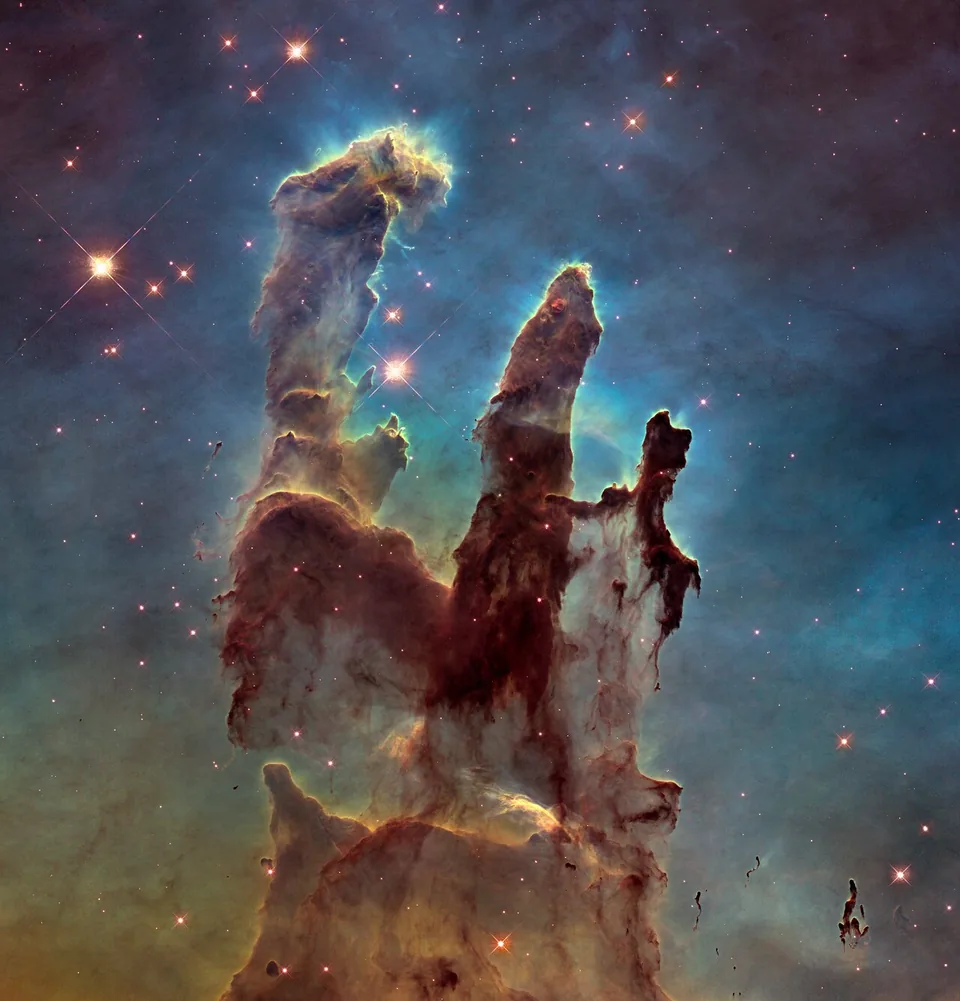
Dusty pillars in the Eagle Nebula, observed with Hubble. Blue, green and red display different narrow wavelength bands rather than the scene's eye colours.
Credit: NASA, ESA/Hubble and the Hubble Heritage Team. Image source · Reuse terms
About this observation
Hubble WFC3, September 2014; narrow-band F502N, F657N and F673N observations; released 5 January 2015. Assigned display colours: F502N [O III] blue; F657N H-alpha+[N II] green; F673N [S II] red. The colours distinguish measured emission-line bands.
Resized for this page; displayed images retain the source's colors and full frame. These images do not share a common physical scale.
This observation shows a structured environment in which stars form. It does not show gravity directly, prove that every dense patch will become a star, or measure the temperature of a hidden core from its displayed colour. A useful next observation changes wavelength: compare the visible and near-infrared views to see how obscuration changes which structures are apparent.
A protostar shines by releasing gravitational energy
Section titled “A protostar shines by releasing gravitational energy”Think of a falling object gaining speed. Its gravitational potential energy decreases while other forms of energy increase. In a forming star, infalling gas collides with other gas, compresses, and heats. Energy released as material settles can emerge as radiation.
The central growing object is a protostar. It gains mass through accretion, the collection of surrounding material. Gravitational contraction and accretion can make it luminous before sustained core hydrogen fusion becomes its main power supply (NASA Hubble Mission Team 2021, opening three paragraphs).
Follow the diagram’s changing energy sources. The arrow toward the main sequence is conditional: enough mass must be assembled to reach the required central conditions. Some surrounding gas is dispersed, and some forming objects remain below the mass needed for sustained core hydrogen fusion.
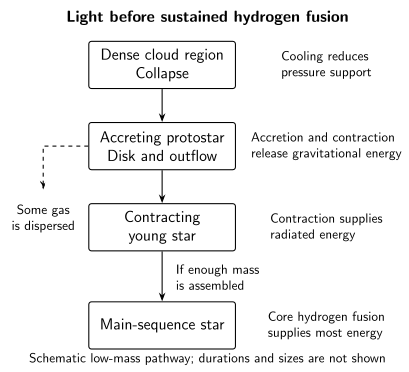
One schematic pathway to a low-mass star. Contraction and accretion release gravitational energy before sustained core hydrogen fusion becomes the dominant source. The final step requires sufficient mass; gas dispersal and lower-mass outcomes are possible. Box spacing and sizes do not encode time or physical scale.
Show the mathematics: an accretion energy estimate
Consider a small parcel of gas of mass falling from far away onto an object of mass and radius . Treat the central gravity as Newtonian and approximately spherical, and suppose is too small to change appreciably. The potential energy is , so the available energy released between a starting radius and is
Here is the gravitational constant. At fixed and , twice the accreted mass makes twice the gravitational energy available. At fixed and , a surface at half the radius gives roughly twice the release if the starting point is very far away.
This is an energy budget, not a prediction that all that energy instantly appears as visible light. A real flow divides energy among radiation, internal heat, motion, and outflows. A disk also distributes the release over different locations. The calculation identifies an available power source without pretending to solve the entire forming star.
A disk and outflows shape the growing system
Section titled “A disk and outflows shape the growing system”Cloud material usually has some rotation. As it falls inward, conservation of angular momentum prevents all of it from heading straight to the center. Gas can settle into a rotating accretion disk. To move farther inward, it must transfer angular momentum to other material or carry it away.
Young stars often drive outflows, including narrow jets directed roughly along the disk’s rotation axis. Inflow and outflow can occur together: some gas feeds the growing star while other gas is expelled. Nearby massive young stars can also disrupt a cloud through radiation and winds. The environment therefore influences how much material a forming star finally retains (NASA, “How Do Stars Form?” and “Exploring Star and Planet Formation”).
A star does not simply inherit the entire mass of the cloud drawn around it. Some matter can form companions, remain in a disk, or return to the surroundings.
Hydrogen fusion changes the long-term power supply
Section titled “Hydrogen fusion changes the long-term power supply”After much of its surrounding envelope has cleared, a low-mass young star can continue contracting. Its center becomes hotter, while its surface appearance also changes. This pre-main-sequence phase is still part of the journey toward a long-lived hydrogen-burning star (NASA 2018, “Life Cycles of Sun-like and Massive Stars,” accompanying explanation).
If enough mass has accumulated, the core can sustain reactions that convert hydrogen into helium. Eventually this supplies most of the energy lost from the surface, and the star settles onto the main sequence. The phrase “sustained core hydrogen fusion” matters: it identifies the long-lived power source, without claiming that no other nuclear reaction can occur earlier.
Fusion is not an outward force. Pressure is higher deeper inside the star, and this pressure gradient can balance gravity. Fusion replenishes energy that helps maintain the hot interior. A star can be nearly balanced mechanically while still slowly contracting and changing; “pressure balances gravity” alone does not mean it has reached the main sequence. Compare the separate force and energy balances in why the Sun keeps shining.
Objects that never become massive enough for sustained hydrogen fusion can instead become brown dwarfs (NASA, “Brown Dwarfs”). What matters is the mass the object actually assembles, not the total mass initially surrounding it. Later life also depends on mass and environment: What happens when stars grow old?
How can we see a star still wrapped in dust?
Section titled “How can we see a star still wrapped in dust?”Visible light from a forming star can be strongly obscured. Infrared observations can reveal radiation escaping through less opaque paths, light scattered from cavity walls, and emission from warm material. Longer-wavelength measurements also probe dust and gas. Different wavelengths answer different questions; one bright shape need not be the stellar surface.
The protostar in L1527, observed by Webb in 2022, offers a useful example. An edge-on disk obscures the central object, while light illuminates material around cavities made by outflows. The well-known hourglass-shaped nebula is surrounding material, not a star with an hourglass-shaped surface (NASA/ESA/CSA/STScI 2022, L1527 explanation).
Astronomers combine such spatial information with spectra, motion, and energy output to test formation models. Observing one object is not watching millions of years of its history in fast-forward.
Explain a luminous young object
Section titled “Explain a luminous young object”An embedded object radiates strongly, but a model consistent with its observations says it has not begun sustained core hydrogen fusion. A classmate concludes that the observations must be wrong: “Without fusion, it cannot shine.” How would you respond, and what would you observe next?
Answer and a useful next measurement
The conclusion overlooks gravitational energy. Contraction and infalling gas can heat the object and its surroundings, which then radiate. Luminosity does not by itself identify the energy source.
An infrared image could help reveal embedded structure, while spectra and gas motions could test for accretion, rotation, and outflow. Measurements across several wavelengths could better estimate the total luminosity. Each supplies evidence for a model; none is a direct photograph of nuclear reactions in the core.
Now change the situation: the gas supply is dispersed before the object gains enough mass. It need not become a Sun-like star. The final outcome depends on the material it actually collects, not on the original cloud’s appearance.
For educators
Prepare a printed formation diagram and a simple sketch of the L1527 cavities described above. The objective is to explain how contraction and accretion can power light before sustained core hydrogen fusion. No astronomy background is needed; the optional energy estimate uses algebra.
For a 5–10 minute activity, annotate each diagram stage with changes in density, temperature, mass, energy source, or surroundings. Ask how an object can radiate while its interior becomes hotter. Expected reasoning includes released gravitational energy, rather than identifying fusion as the only possible light source or as a mechanical force.
For a 20-minute investigation, separate descriptions of L1527 into observed structures and physical interpretations, then remove the gas supply from an imagined forming object. Successful answers explain why an hourglass-shaped nebula is not the stellar surface and why an interrupted supply may change the final mass and outcome. Use paper arrows to show that accretion and outflow can coexist; no device is required.
To compare young stars with other stars, first separate luminosity from received brightness, then explore the H–R diagram.
References
Section titled “References”- ESA/Hubble (2015). New View of the Pillars of Creation—Visible. Image heic1501a, 5 January 2015. Observation, instrument and colour information.
- NASA. Chapter 1: A Star Is Born. Formation account.
- NASA (2018). Life Cycles of Sun-like and Massive Stars. Webb learning resource, 31 May 2018. Accompanying explanation.
- NASA. Types of Stars. Section “Brown Dwarfs.” Stellar and substellar objects.
- NASA. Webb’s Star Formation Discoveries. Sections “How Do Stars Form?” and “Exploring Star and Planet Formation.” Science explanation.
- NASA/ESA/CSA/Space Telescope Science Institute (2022). NASA’s Webb Catches Fiery Hourglass as New Star Forms. 16 November 2022. L1527 observations and interpretation.
- NASA Hubble Mission Team (2021). Hubble Spies Newly Forming Star Incubating in IC 2631. Goddard Space Flight Center, 17 November 2021. Protostar energy and infrared observations.
Further reading
Section titled “Further reading”For an optional derivation of how gravitational binding, motion, and energy loss are related, read Conservation Laws, Scaling, and the Virial Theorem. Its averaging assumptions matter when applying it to a contracting cloud. Preparation: calculus and Newtonian mechanics.